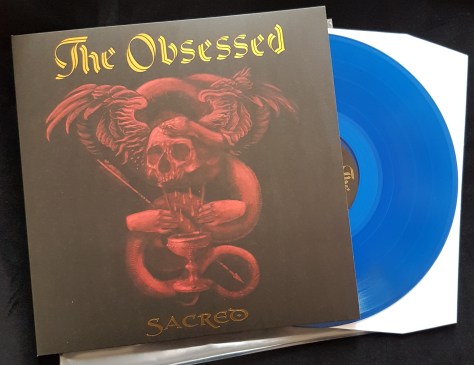
The European edition – 2LPs (Blue and Red) with bonus tracks
“Steal and lie to get your fix”
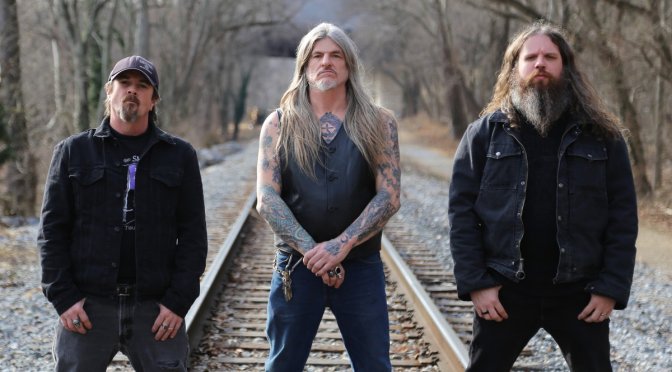
Here’s a fantastic track from Sacred, the new album from The Obsessed. I mentioned the other day that hearing just 30 seconds of this song was enough to sell this album to me, and I’ve not been disappointed. It’s mostly built around an irresistible wind-in-the-hair Motorhead riff but the song peaks with its pounding bar-fight of a chorus. From the lyrics I gather the victim of the crushing is more likely to be a punk of the “worthless person” variety than a punk of the musical persuasion. Either way, this songs deals out a no-nonsense crushing, pure and simple… and that’s why it’s song of the week. Enjoy.
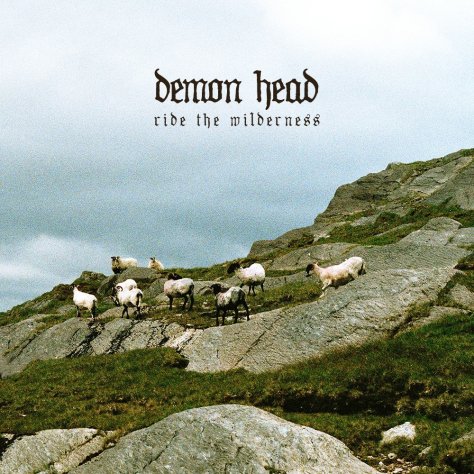
It’s officially summer now but winter darkness reigns eternal in the heart of the HMOverlord so here’s Winterland by Copenhagen’s Demon Head. Taken from their 2015 album Ride the Wilderness, we’re in firmly retro territory here, harking back to the vintage proto-metal of Pentagram or even the heavier bluesy bands like Fleetwood Mac. The band’s sound is refreshingly clean and warm, the heaviness coming from the doom-laden riffs and delivery. And Ferreira Larsen’s excellent Bobby-Liebling-meets-Glenn-Danzig vocals are cultishly addictive. It’s great stuff from a very promising debut album. If you like this, the bands entire digital discography can be acquired very cheaply via Bandcamp and keep an eye out the follow-up album Thunder On The Fields, due out in April 2017.
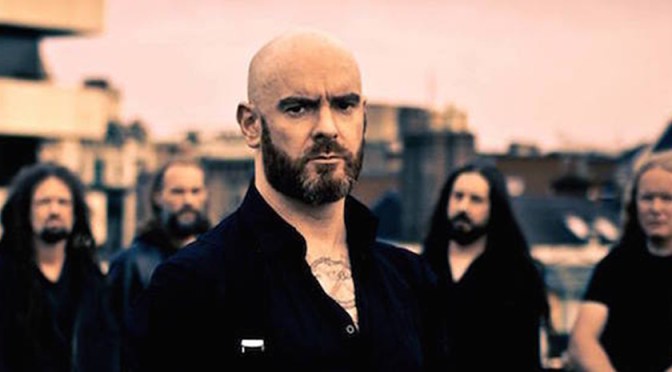
Candlemass bassist/songwriter Leif Edling has dubbed his latest project “music from the catacombs” as it was a visit to Paris’ bone-ridden underworld that inspired its creation. It’s an apt description. With The Doomsday Kingdom’s debut EP Never Machine, Leif’s music goes deeper and darker than it has for some time. The opening title-track and The Sceptre stick fairly close to Candlemass’ modern style but Niklas Stalvind’s grave and gravelly vocals and Marcus Jidell’s excellent, vintage soloing give the songs a fresh, grittier edge. But it might just have been a decent, unremarkable release if it wasn’t for the more interesting and engaging second-half. Zodiac City is a coiled and creepy serial killer yarn with a great chorus hook and the EP ends on a high with Edling taking the mic for The Whispering, a haunting and ghostly string-laden ballad. Never Machine doesn’t quite reach the inspired heights of Leif’s classic output but it’s a real grower and a definite improvement on last year’s half-(Candlem)assed EP Death Thy Lover. Candlemass might have fallen out of favour but these demos show promising signs that Edling still has what it takes to reign again as a king of doom.
(Here’s my copy. It’s the new edition released by Nuclear Blast. With new artwork, lyric sheet and red vinyl)
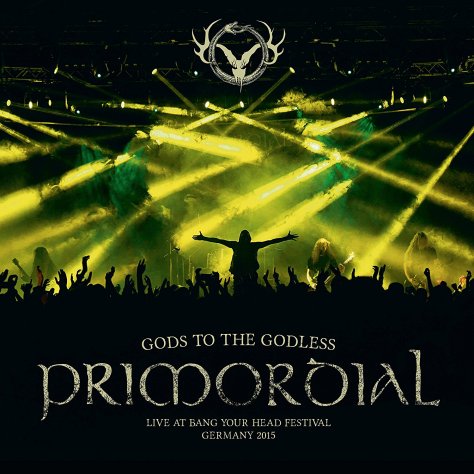
Here’s a rousing track from Primordial’s new live album Gods to the Godless (Live at Bang Your Head Festival Germany 2015). I always feel like live shows are defined by the inclusion of new tracks. My memories of live performances usually revolve around the new songs that were played. For better or worse, bands seem to put extra welly into the new stuff: meaning that brilliant new songs make for an unforgettable show but weak ones will likely mar my recollections, no matter how classics-laden the show might have been. The former is definitely the case with Primordial. Four of the eleven songs here are taken from their last album Where Greater Men Have Fallen and here’s an amazing version of the title track: a burly and martial take that surpasses the studio version. Alan Nemtheanga proves himself, once again, the consummate metal frontman, and the band’s chemistry and the skill of their arrangements are even more evident in the live setting: every instrument occupying a unique space to create a massive wall of sound. Primordial, over twenty years into their career, sound like they’re determined to remain impassioned and vital until the bitter end.
[To hear the Song of the Week, click track three on the YouTube screen below. And then listen to the whole thing, you won’t regret it]
Fans of 2014’s excellent Promulgation of the Fall would have been hoping for more than just two tracks from these Greek death metallers this year but their new EP Sombre Doom satisfies with quality over quantity. Opening with a howling dead wind of feedback, the first track Redemptive Immolation is grave and doom-laden with a thick, dark atmosphere. After the oppressive opener, the up-tempo battering of Wind’s Bane comes as a relief but is still rich in ghostly gloom and haunting guitar. The songs and riffs aren’t the most original but Sombre Doom is all about the vibe and the execution: this reeks of rain, death, evil and graveyards. Proper death metal if you ask me, and one of the best EPs of the year.
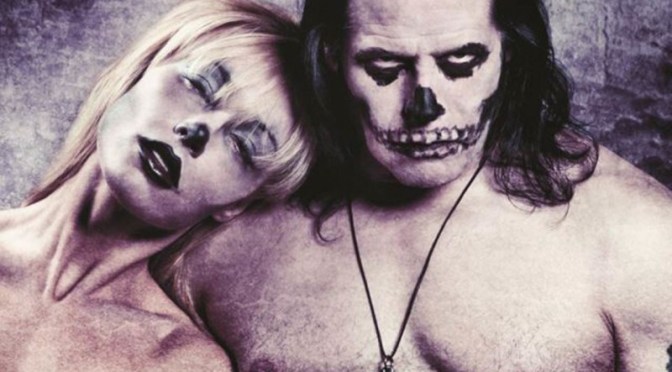
Glenn sees your “Dad-bod” and raises you a “Danz-bod”
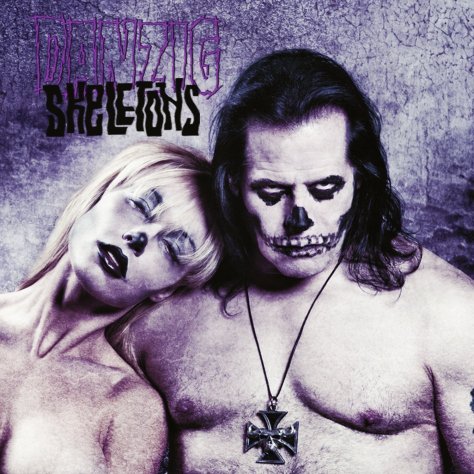
The covers albums is almost always a dodgy proposition but I couldn’t help but hold out some hope for Danzig’s Skeletons. Partly because… Glenn F. Danzig! But also cause I knew the Evil Elvis was going to choose some interesting material to put through the metal wringer. And it’s the choice of material that saves Skeletons from being a total stinker. The performances are pretty ropey: flat vocals, lifeless drums and relentless guitar squealies along with a flabby sound that’s devoid of dynamics. There are dicey renditions of Sabbath’s N.I.B, Aerosmith’s Lord of the Thighs and ZZ Top’s Rough Boy, while a surprising choice, sounds like your drunken Dad commandeering the microphone at a wedding. Dad, stop! But Danzig gets bonus points for doing all these tracks his own way and, when you’ve got Glenn M. F. Danzig doing The Everly Brothers’ Crying in the Rain, it’s hard not to get a kick out of that… however much it sounds like the karaoke of your darkest fears. It’s worth having Skeletons just for that and its opening trio of tunes: Dave Allan and the Arrows’ Devil’s Angels is bashed out in delightfully Misfits-y style; the obscure soundtrack curio Satan (Theme from Satan’s Sadists) is brilliant and tailor-made for Glenn – “I was born mean, by the time I was 12 I was killing, killing for Satan”; and his cover of Elvis’ Let Yourself Go is a stomping taster for his planned Elvis EP. It’s definitely for fans-only but, for them, it’s a flawed-but-loveable glimpse into the great Fonzig’s interesting and eclectic influences. And if you’re not singing “I was borrrrn mean…” in the shower every day after hearing this, you’re a better man than me.
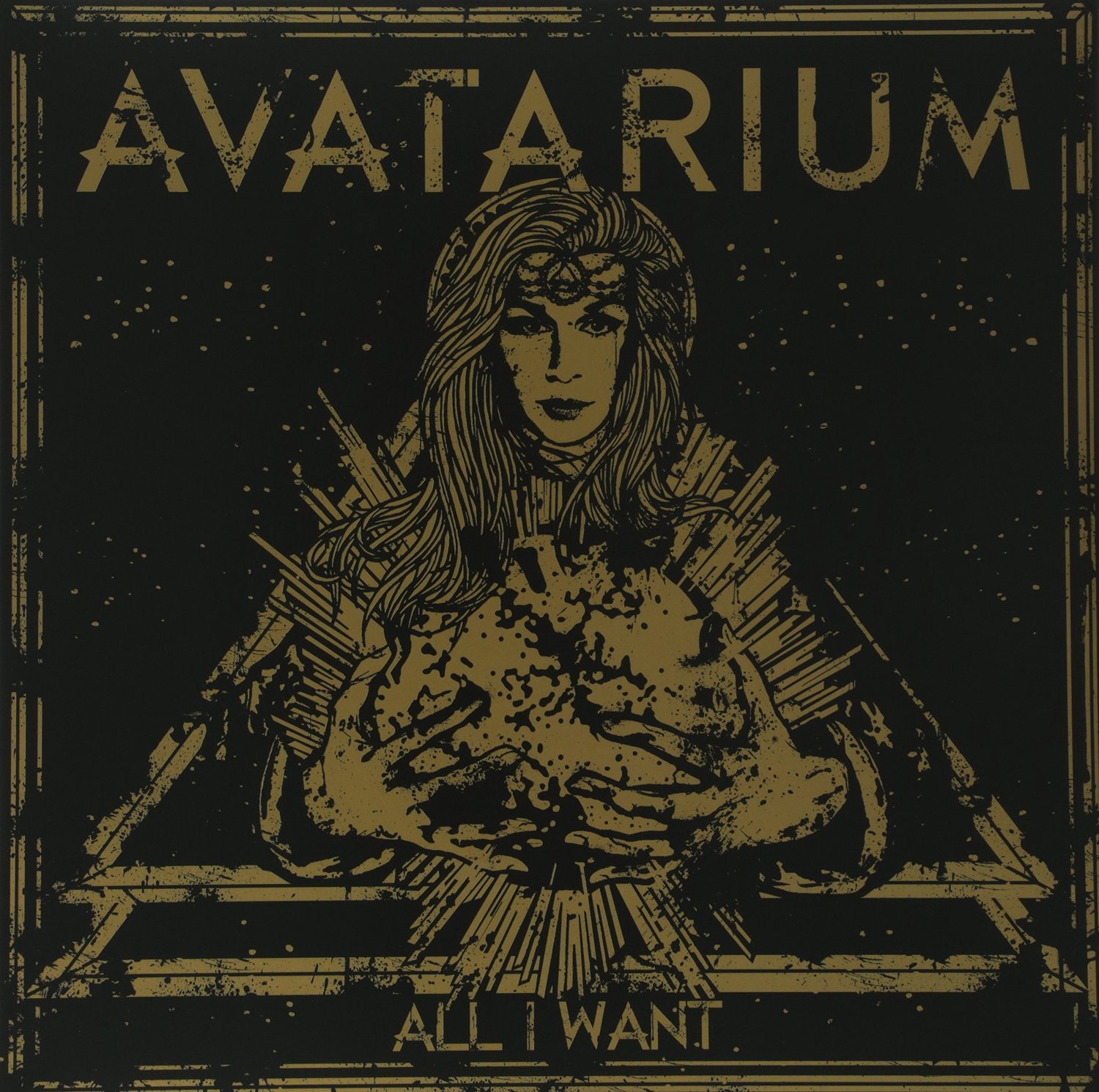
Their self-titled album Avatarium was one of 2013’s surprise delights and one of the strongest debuts of recent years. What I really want is a proper follow-up album but, in the meantime, All I Want will do nicely. With just two new songs and three live recordings, it’s essentially a stop-gap until the next full album. But this 2014 EP is well worth hearing in its own right, offering evidence of their evolving and gelling sound as the band hit a new richness of depth following their first live shows.
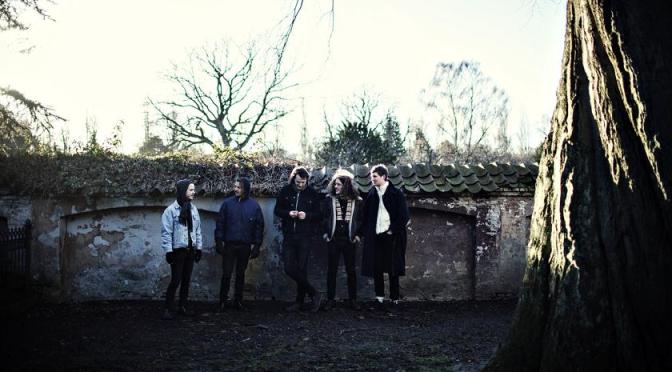
Vexed by the typically variable Scottish weather, the band hedged their bets.
Formed by Candlemass’ Leif Edling, Avatarium hadn’t performed any live shows when they recorded their debut album so it’s interesting to hear how they deliver live. Taken from their spot at the Roadburn Festival, the three live tracks are all excellent. It’s especially impressive to hear Jennie-Ann Smith’s vocals in the live setting. She’s an incredible discovery: delicately soulful, ominously powerful and one of the best singers around today. The band ably replicates the studio versions, the crushing Dehumanizer-grade weight of Marcus Jidell’s riffs are just as potent live but the psychedelic side of the music is more apparent as Carl Westholm’s keyboard textures are allowed more room to breathe. And Jidell’s lead guitar is looser, more confident. His outstanding Blackmore-esque solo on Pandora’s Egg draws appreciative cheers and he takes the Tides of Telepathy solo into a Hendrix-inspired section that lifts the song to new classic heights.
But the main event is the two new songs. They continue in the same vein as the debut but the more expansive chemisty, evinced by the live tracks, feeds into both: they sound richer and more colourful than the tracks on Avatarium. All I Want is a groovy rocker, graced with Edling’s seemingly infinite supply of golden hooks and drenched with Hammond organ and a percussive passage right out of Zeppelin. Fittingly, Deep Well is a deeper, darker experience. The swampy vamp and soulful vocals lifts into a chilling chorus. The dread of the thick, heaving chords graced with the subtle, rising power of Wilson’s vocals is monumental in the way only the best Doom can be and one of Avatarium’s greatest triumphs to date.
Mah copy
So, while it is a stop-gap release, All I Want is a satisfying and enlightening listen in its own right. Existing fans will welcome the new songs and new flavour the live tracks add to the older material. And given that the new songs rank among the very best the band has yet recorded it serves as a potent introduction for newcomers. The EP deserves to draw new fans into Avatarium’s increasingly deep, dark well.
Considering the huge impact Italy has had on the world of horror movies since the 60s, it’s hardly surprising that the first Italian Heavy Metal band was steeped in the sepulchral atmosphere of the graveyard. Death SS were formed in 1977 by guitarist Paul Chain (the “Death”) and vocalist Steve Sylvester (The “Vampire” whose initials also provided the “SS” of the band name). The band was rounded out by guitarist Claud Galley (The “Zombie”), bassist Danny Hughes (the “Mummy”) and the superbly-monikered Thomas Hand Chaste (the “Werewolf”) on drums. If the Village People ever went Hammer Horror they would probably end up looking something like Death SS.
Although they toiled in obscurity, Death SS still managed to release demos and some privately pressed singles. The Zombie/Terror 7” is the earliest of those singles, an extremely rare release that has now been exhumed and reissued by Svart Records. A-Side Zombie is a 1979 demo version recorded at a rehearsal and B-Side Terror is a rough live take from 1980. Both are horrible, crudely performed and even more crudely recorded. But an inspired and creative magick cuts through the sonic fog. Naively simple but ominous riffs are topped with chiming, ethereally spooky guitar melodies and the vocal hooks in both songs are immediate and melodic enough to endure Sylvester’s cheese-grater vocals. The ugly rawness of the production and singing also strengthens the dark, occult atmosphere: a method that many Black Metal bands would make a virtue of years later.
My copy
You could draw style connections via the Italians from Killer-era Alice Cooper through to the Black Metal genre but Death SS don’t really sound like anyone else. Their otherworldly eeriness, melodic nous and the murky, macabre shroud of sound makes for a darkly seductive listen that I’d strongly recommend to fans of occult/horror-themed Metal. Superior versions of both these songs can be found on the essential The Story of Death SS 1977 – 1984 compilation so newcomers should start there. But for existing fans this single is a great opportunity to own more of this obscure band’s rare and early work and to hear their first lumbering steps from beyond the grave.
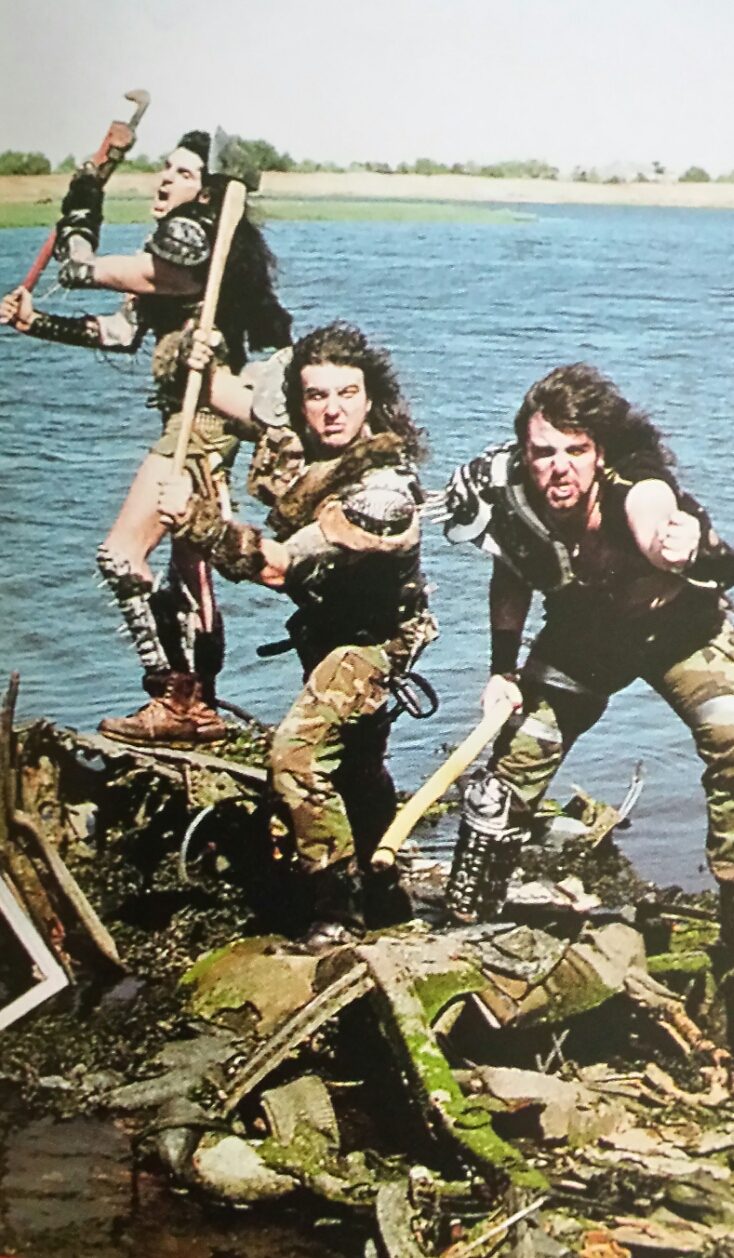
Greetings and felicitations, children of technology. Welcome to the post-apocalyptic world of Carnivore. Few bands are hardy enough to survive thermonuclear destruction but, led by the imposing Petrus T. Steele, this trio of New Yorkers had what it takes to survive World War III (and IV.)
They’re meat eaters, they’d like to meet ya
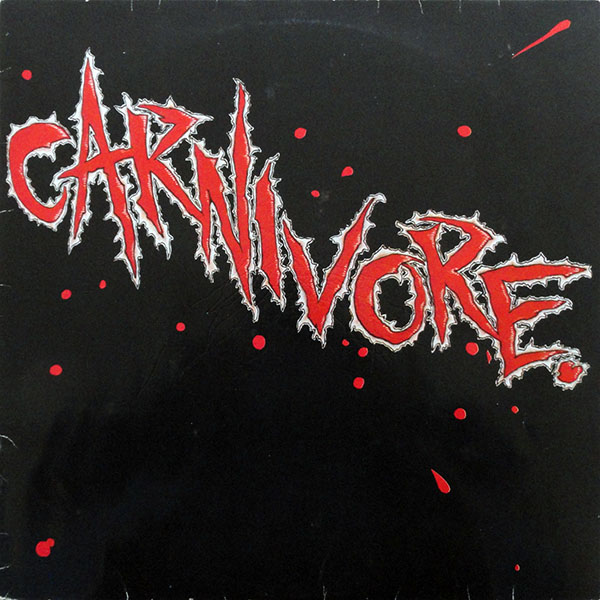
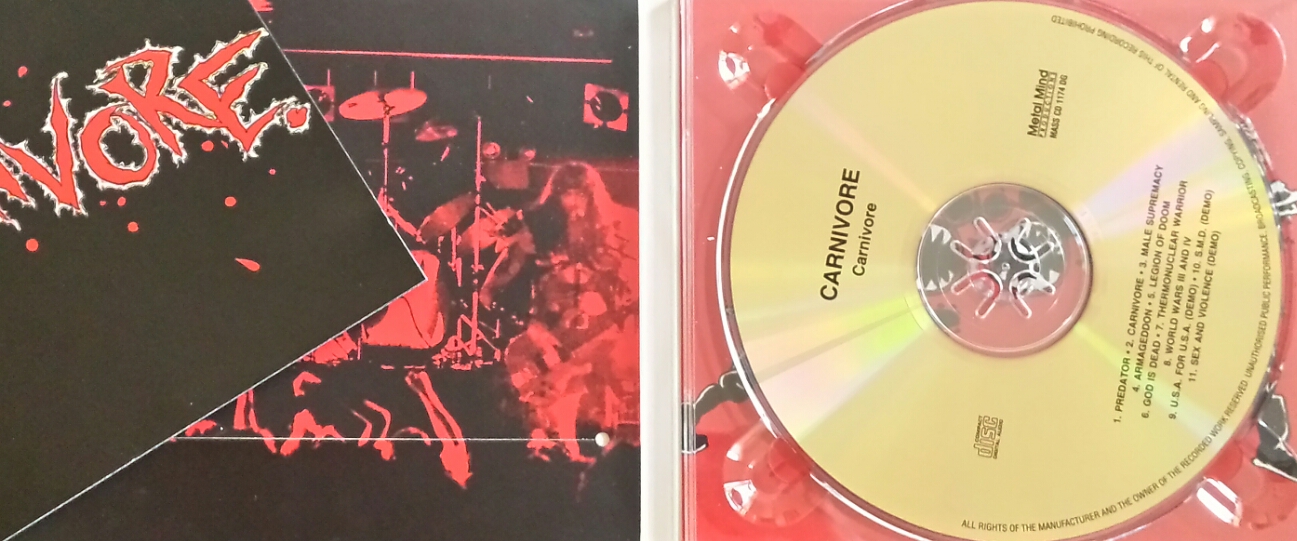
Along with Keith Alexander on guitar and Louis Beateaux on drums, Petrus and Carnivore unleashed their S/T debut album in 1985. It’s a raunchy and primitive mix of Punk and Metal with a hefty dose of Doom and Steele’s beefy vocals. Although the style is crude the performance is tight with live energy and just enough production effects to sound suitably futuristic. Predator kicks the proceedings off and sets the scene of life beneath the rrrrruined city. Male Supremacy has a dirty Crüe-style opening riff and unforgettable chorus. Armageddon has rampaging Crossover Thrash velocity and another golden chorus hook. There are also playful, musical detours: God is Dead’s chorus is mellow bongo-driven weirdness and Male Supremacy culminates in romantic balladry as Petrus returns home to his woman after a hard day’s war.
Metal Mind/Roadrunner Ltd Edition
The second side dips a little compared to the stronger first half but is saved by the more remarkable Doom sections (the “Crush Kill Destroy” section of Thermonuclear Warrior for example) and the rollicking, propulsive World Wars III and IV which ends the album on a high. Lyrically, Carnivore stick to what they know: the life and philosophy of post-apocalyptic, cannibal barbarians hunting for unsuspecting victims to chow down on. It’s something we can all relate to. The whole album is right up my Venom-loving street: filthy and rowdy with the hyper-masculinity of Manowar and a pre-GWAR sense of fun and mythology that wisely stops short of out-and-out comedy.
My copy
Alternative front cover for a 2001 reissue
Petrus T. Steele would later change his name to Peter Steele and go on to great success in his next band Type O Negative. There is very little of Type O’s seductive, swooning October Rust style here but there are plenty of other similarities: the Hardcore elements of Type O’s debut Slow, Deep and Hard and later tracks like Kill All the White People. The shock-tactic humour, bass-heavy Doom riffs and songwriting chops are also heavily indicative of Steele’s future musical direction. Despite their talent for post-nuclear survival Carnivore only lasted for one more album before calling it a day but their music has proved more resilient. Carnivore is full of choice, prime cuts. Bon Appetit.
The 1986 debut record of Sweden’s Candlemass casts the kind of pure Heavy Metal spell you’d expect to find scrawled in some dusty old grimoire found in a subterranean chamber. As well as giving the Doom Metal genre its name, the album’s title also describes its contents perfectly. Six ancient tales of myth, legend and tragedy told through Metal of portentous and quaking heaviness.
On Epicus… bassist and songwriter, Leif Edling, offers up a treasure-trove of timeless riffs, all heftily delivered by rhythm guitarist Mats “Mappe” Bjorkman, from the snaky, neoclassical riffs in Demons Gate and Crystal Ball, to the windswept bludgeon that opens Black Stone Wielder and the Am I Evil-esque riff that fires up Under the Oak. In addition to the lumbering guitars, the album’s acoustic passages and doleful harmonies add a bleak, gothic atmosphere.
Vocalist Johan Längqvist’s baritone is sincerely and chillingly emotive: anguished in funereal opener Solitude and channelling some arcane evil in Crystal Ball. He tells all of Epicus’ tales with theatrical flair and melodrama. Lead guitarist Klas Bergwall provides chinks of light and a very European flavour with his lyrical, neo-classical leads and drummer Matz Ekström proves to be the album’s secret weapon, filling the gaps between snail-paced chords with massive fills that sound like the raging elements.
It’s surprising, considering the musical chemistry and cohesiveness, that Candlemass wasn’t really a band at this point. They had been signed to France’s Black Dragon label on the strength of Edling, Bjorkman and Ekström’s demos. Längqvist and Bergwall were hurriedly drafted in for the album’s recording sessions but were uninterested in joining the band on a more permanent basis and after the recording finished, Ekström left the band too. Despite a positive critical reception, Epicus… sold poorly but the next line-up of Candlemass would record another masterpiece that helped boost the reputation of the band, sending many back to the debut.
The legend of Epicus… would grow in stature over time, becoming a mainstay of best-album polls and increasingly cited as an important influence by other bands. While forever associated with its titular sub-genre, it’s a timeless, magical classic for Metal fans of all stripes and still casts a powerful spell to this day.








 HEAVY METAL OVERLOAD