Category Archives: Thrash Metal

Savage – Let it Loose (Song Review)

“We’re not here to read your rights”

Savage’s relatively late debut album (1983’s Loose N’ Lethal) might make them seem like one of the few New Wave of British Heavy Metal bands that couldn’t lay a claim to being an influence on the mighty Metallica. But, far from being Johnny-Come-Latelies, Savage had already been around for a while. By 1981 they had already released a demo, a single and made two appearances on a compilation album Scene of the Crime. One of those compilation tracks was the classic Let it Loose and it soon made its way into the hands of, you guessed it, Lars Ulrich. Only appearing in early Metallica live sets and on a demo tape, it’s not one of the more famous or celebrated Metallica NWOBHM covers but there’s a strong whiff of the thrash giants’ early style here. And although ‘tallica didn’t exactly pass it off as one of their own they weren’t in a hurry to draw attention to the fact that it was a cover either. And, if any listeners thought it was one of their own original songs, that was fine by them too. Have a listen to the 1981 Scene of the Crime version of the track here to hear why.

[Savage – Let it Loose]

Coroner – Son of Lilith (Song Review)

497

“I’ve got the moon in my veins”

The Swiss power trio Coroner has often been called the “Rush of Thrash” for their progressive bent and formidable performances. And their albums don’t get much more progressive and formidable than their fourth, 1991’s Mental Vortex. Here’s one of my favourite tracks from it, Son of Lilith. It’s still got enough crunch and neck-snapping intensity to please thrashers but this song is more about precision and groove. It’s got an earworm of a chorus and a guitar solo to die for. Total class.

Nocturnus – Destroying the Manger (Song Review)

640

“Chronometer reading 0 B.C.”

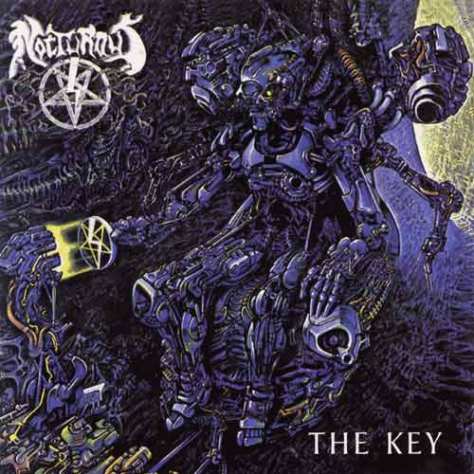
As my Top 10 Albums of the Year proved, “death metal in space” was a big thing in 2016. So let’s travel back in time to 1990 and the album that started it all: Nocturnus’ The Key and this excellent blast of sci-fi horror. Some sort of evil cyborg has invented a time machine and set a course for the date 0 B.C. He has only one goal: kill the baby Jesus!

“Blasting away Father, Mother, and Child/laughing hysterically all of the while” the cyborg proves to be devastatingly successful in his mission. And Destroying the Manger proves devastatingly successful too: a wild shred-fest of riffs and solos that gets down to serious moshing business at 4:10. And check out the prominent keyboards too… Nocturnus going where no death metal band had gone before.

Skyclad – Tracks From the Wilderness (EP Review)

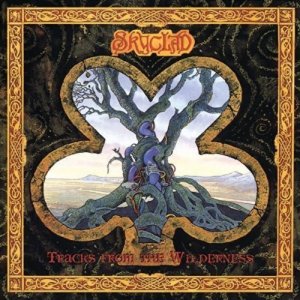
What makes a great cover version? There’s only one question you have to ask: does the band covering the song make it their own? Skyclad’s cover of Thin Lizzy’s Emerald is excellent. It’s faithful to the original song but the more metallic, aggressive and threatening delivery along with the clever use of violin to handle the chorus riff and bridge ensures the song fits perfectly in Skyclad’s folk metal oeuvre. Extra points awarded for guest guitar from Lizzy’s ‘Robbo’ Robertson and the fact that this version is responsible for me getting into Thin Lizzy in the first place! Even if I (and probably you) ultimately prefer the original there is no denying this is an inspired and enjoyable cover version.

Emerald opens their 1992 EP Tracks From the Wilderness and is followed by two studio cuts that sadly don’t keep up the standard it sets. A Room Next Door is a decent ballad with beautiful, rustic acoustic guitars but When All Else Fails is forgettable thrash. Neither are in the same league as the Lizzy cover or up to the quality of the tracks on the band’s previous two albums. The lack of Fritha Jenkins’ violin on these suggests they were probably off-cuts from the band’s debut album. The EP closes out with three energetic and endearing live tracks from the Dynamo festival. The band are tight and Martin Walkyier delivers each song with zeal. These excellent performances round out a worthwhile stop-gap release but there’s no denying this is mainly worth buying for Emerald. For fans only.

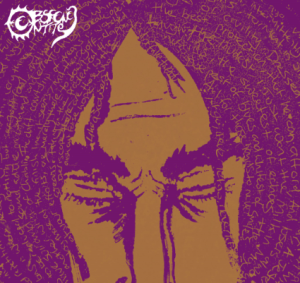
Obscene Entity – Lamentia (Album Review)

Obscene Entity - Lamentia (2015)
Obscene Entity – Lamentia (2015)

As Obscene Entity power into the climatic riff of the track Insanity Binds, someone shouts the word “fuck”. Now, normally that kind of posturing would have me rolling my eyes, thinking of Lars Ulrich. But the particular moment at which it is exclaimed, after the band have just powered through a veritable maelstrom of death metal riffs before returning successfully to the song’s main riff, it comes across as totally genuine. Even triumphant. You find yourself totally behind them. Fuck!

I can’t think of a better way to illustrate the joy of Obscene Entity’s debut album Lamentia.

Loosely based around the theme of mental fragility, this intense and heartfelt album pulls you down a rabbit hole of tortured death metal. The album starts off with the Gojira-fronted-by-Jeff Walker assault of Planetary Devastation. It’s a good, solid opener but the album kicks into another gear as Hymns of the Faithless veers from a dizzy, swirling riff midway through the track into a groovy, stop-start breakdown. It’s the kind of stuff that makes you gurn like Phil Anselmo. Listen to this on the bus at your peril.

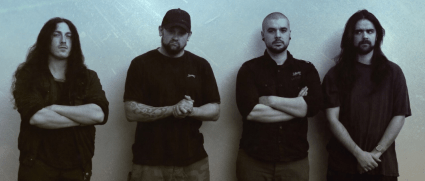
Obscene Entity - now a four piece!
Obscene Entity – upgraded to a four-piece since Lamentia was completed

And from there on the album just seems to intensify, the band continually adding new elements and styles. The title track has a whirling dervish riff and ringing chords that bring to mind Emperor and Euphoric Vanity employs some guitar progginess in a wonderful Chuck Schuldiner vein. The twin vocals of guitarist Matt Adnett (also of Shrines) and bassist Calum Gibb keep things varied throughout: ranging from brute Behemoth growls to hoarse blackened snarls. But the top honours go to drummer Luke Braddick. For an album this vehement, it’s remarkably hooky and those hooks are powered and enhanced by Luke’s dynamic and tasteful playing. Throughout, the band plays a modern style but has a classic sensibility and chemistry: constantly reining themselves in, allowing space for all the parts to have maximum effect. This quality, aided by the powerfully clear production from Dan Abela, only adds to the album’s power and intensity.

There are a lot of approaches and influences on Lamentia and my only concern is that the band haven’t quite found their unique voice yet. But it’s never derivative and the prospect of the band developing and finding that voice on future releases is tantalising. But until then, there’s plenty to enjoy and gurn at in Lamentia. It’s unreconstructed death metal performed with remarkable skill, piss and vinegar. Expect to see this in my end-of-year Top Ten, it’s a fantastic debut. Fuck!

Obscene Entity on Bandcamp:  http://obsceneentity.bandcamp.com/

Obscene Entity on Facebook: https://www.facebook.com/ObsceneEntity/

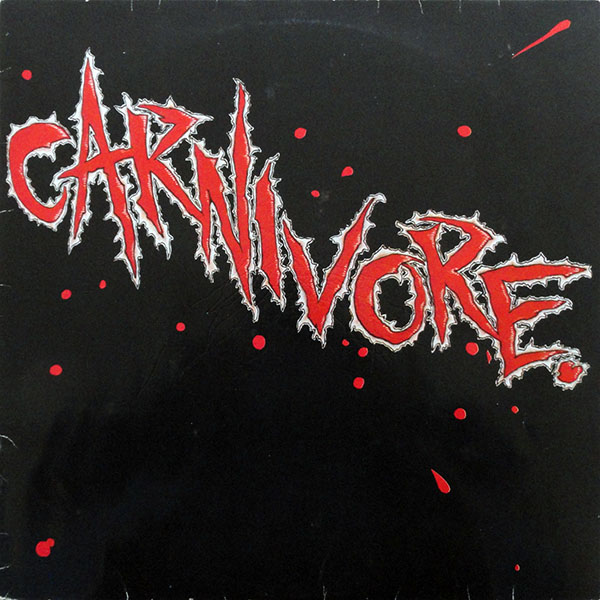
Carnivore – Carnivore (Album Review)

Carnivore - Carnivore (1985)
Carnivore – Carnivore (1985)

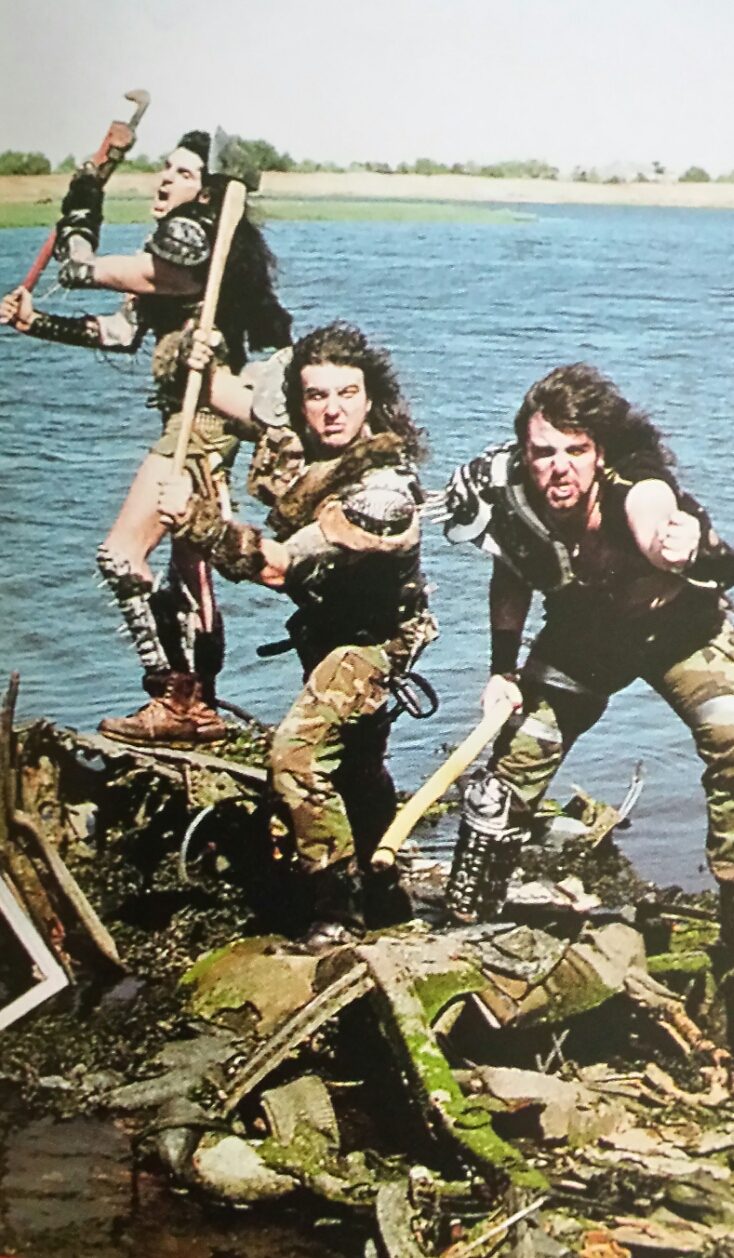
Greetings and felicitations, children of technology. Welcome to the post-apocalyptic world of Carnivore. Few bands are hardy enough to survive thermonuclear destruction but, led by the imposing Petrus T. Steele, this trio of New Yorkers had what it takes to survive World War III (and IV.)

They're meat eaters, they'd like to meet ya
They’re meat eaters, they’d like to meet ya

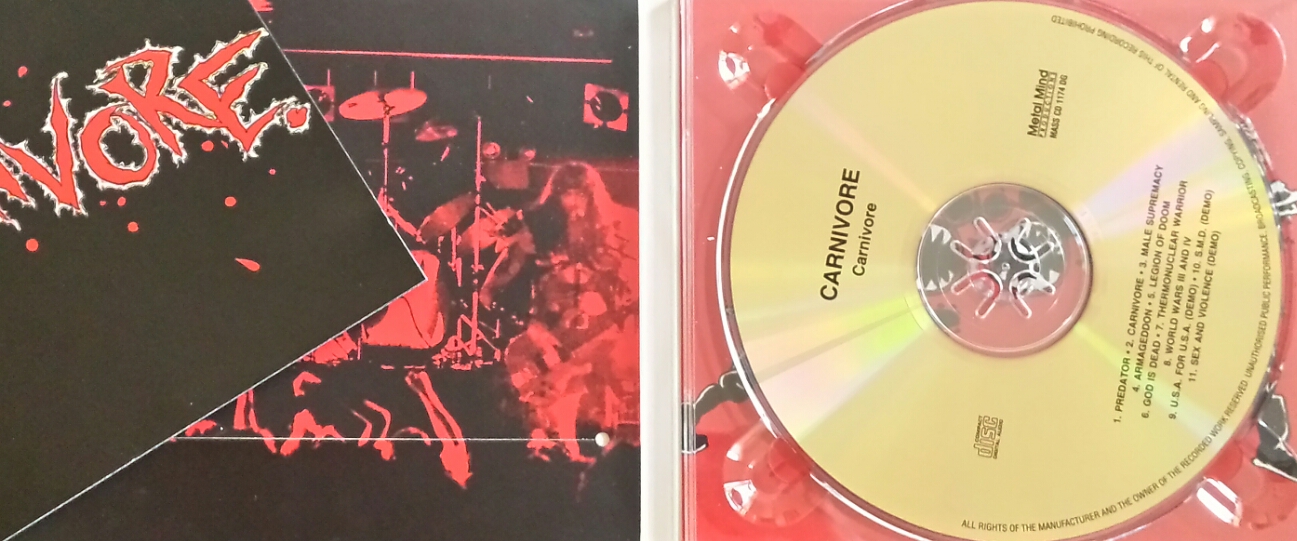
Along with Keith Alexander on guitar and Louis Beateaux on drums, Petrus and Carnivore unleashed their S/T debut album in 1985. It’s a raunchy and primitive mix of Punk and Metal with a hefty dose of Doom and Steele’s beefy vocals. Although the style is crude the performance is tight with live energy and just enough production effects to sound suitably futuristic. Predator kicks the proceedings off and sets the scene of life beneath the rrrrruined city. Male Supremacy has a dirty Crüe-style opening riff and unforgettable chorus. Armageddon has rampaging Crossover Thrash velocity and another golden chorus hook. There are also playful, musical detours: God is Dead’s chorus is mellow bongo-driven weirdness and Male Supremacy culminates in romantic balladry as Petrus returns home to his woman after a hard day’s war.

Metal Mind/Roadrunner Ltd Edition

The second side dips a little compared to the stronger first half but is saved by the more remarkable Doom sections (the “Crush Kill Destroy” section of Thermonuclear Warrior for example) and the rollicking, propulsive World Wars III and IV which ends the album on a high. Lyrically, Carnivore stick to what they know: the life and philosophy of post-apocalyptic, cannibal barbarians hunting for unsuspecting victims to chow down on. It’s something we can all relate to. The whole album is right up my Venom-loving street: filthy and rowdy with the hyper-masculinity of Manowar and a pre-GWAR sense of fun and mythology that wisely stops short of out-and-out comedy.

Petrus T. Steele would later change his name to Peter Steele and go on to great success in his next band Type O Negative. There is very little of Type O’s seductive, swooning October Rust style here but there are plenty of other similarities: the Hardcore elements of Type O’s debut Slow, Deep and Hard and later tracks like Kill All the White People. The shock-tactic humour, bass-heavy Doom riffs and songwriting chops are also heavily indicative of Steele’s future musical direction. Despite their talent for post-nuclear survival Carnivore only lasted for one more album before calling it a day but their music has proved more resilient. Carnivore is full of choice, prime cuts. Bon Appetit.

Murder in the Front Row – Harald Oimoen and Brian Lew (Book Review)

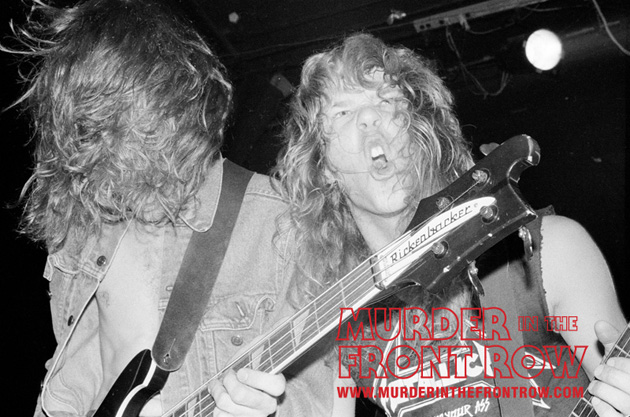
I was initially disappointed when this hardback turned up in the post. I wasn’t convinced a book crammed with photos of young, sweaty guys gurning and flipping their middle fingers was something I’d want to look at very often. But I was missing the point. Bazillion Points are doing a great service to Metal with books like this. Harald Oimoen and Brian Lew were part of the Bay Area Thrash scene from the very beginning and Murder in the Front Row is a beautifully put together documentation of the movement as seen through their lenses.

Oimoen and Lew contribute written recollections of their involvement with the genre, along with contributions from Ron Quintana, Gary Holt, Alex Skolnick and Robb Flynn, but the main attraction is the atmospheric photography. Many historic moments and formative band line-ups are captured here. Metallica feature heavily. There are great shots of the Mustaine/McGovney line-up as well as the very first photos of the band with legendary bassist Cliff Burton. While Exodus’ importance in the scene is often overlooked, they are given the profile they deserve here and, mainly due the larger-than-life presence of frontman Paul Baloff, they embody the wild and chaotic vibe of the movement. They also provide the book’s title via the lyrics of their classic Bonded by Blood.

4

Being an LA band, Slayer’s earliest eye-liner days aren’t included but by the time they hit the Bay Area they were already a darker and more visually striking prospect. The images of their first Bay Area shows seem to leap out of the book and Oimoen was on hand to capture Kerry King’s short-lived stint as guitarist in Megadeth. His spike-wristed appearances in early ‘Deth shows provide some of most fascinating sights in the book. The early Megadeth shows also illustrate the changed attitude of Dave Mustaine: his determined, sneering demeanour speaking volumes about his intent following his dismissal from Metallica.

Alongside the obvious main players, the grassroots moments of many other crucial bands are also included along with plenty of backstage meetings, drunken antics and – a crucial element often overlooked by professional Rock photographers – fans like Toby Rage who illustrate (often in mid-air) the audience mayhem these bands became notorious for.

So, although on first glance this is a book of photos of young sweaty guys, the authors’ dedication to the genre and their candid amateur photography turns it into something more: a brilliant evocation of the blood, sweat and beers of a unique and vibrant scene. Murder in the Front Row is essential for fans of the genre: it tells the story of Bay Area Thrash Metal more effectively and honestly than a bazillion words ever could and is the next best thing to having actually been there.

Venom – Welcome to Hell (Album Review)

Venom - Welcome to Hell
Venom – Welcome to Hell

Extreme Metal pioneers Venom waged war from the very depths of Hell, raging against the early-80s New Wave of British Heavy Metal bands they considered tame and the heroes that they felt had pulled their punches.

They combined the filth and fury of Punk and Motörhead with the larger-than-life images of KISS and Priest and the kind of Devilish allegiance that would have Sabbath crying “Please God help me!” Conrad, Tony and Jeff became the far more demonic-sounding Cronos, Abaddon and Mantas and their classic album cover set out their allegiance to Beelzebub in black and gold. And they had the sound to match their demonic image.

Another trip to the beach ruined

The band used demo sessions for the final album, signalling their primitive purity and honesty. Welcome to Hell sounded under-produced and unholy. The Motörhead influences are obvious, especially in the opening tracks Sons of Satan and Welcome to Hell, but the brio with which they mangle these rockers is thrillingly rudimentary. Cronos’ appropriately named “Bulldozer” bass piles over everything, Mantas peels off some fun wild solos and Abaddon’s caveman drumming tries to keep up. The sense of limits being pushed gives the performance a chaotic edge, especially during the lurching changes of pace. The debauchery of tracks like Poison and Red Light Fever is often criticized but really it all just adds to the shock factor and what’s the point of being one of the Great Horned One’s Legion if you can’t indulge in a bit of hellraising hedonism?

On Side 2 the band enter more original and scarier territory. Witching Hour is seminal proto-Thrash, Angel Dust is face-ripping and In League with Satan is addictively catchy while still sounding ominous and threatening. The band tightens their Metal grip as the album progresses and the most influential musical moments come from the record’s second half. Welcome to Hell has many elements of the Heavy music that preceded it and its fast pace, growled vocals and evil vibe can be heard in so much Metal that came after. But it remains unique and divisive. In fact, it’s a hellish maelstrom of just about everything I love about Heavy Metal while also embodying everything the genre is criticised for.

Venom’s raw, no-holds barred approach would prove to be massively influential on Thrash, Death and particularly Black Metal. Although Venom hadn’t gotten around to christening it yet, many key components of BM began here: particularly the occult, evil atmosphere and rotten production values but also the iconography, aliases and instrument descriptions (Bulldozer Bass, Chainsaw Guitars and Nuclear Warheads!)

But most importantly, Venom’s greatest legacy was their harder/faster/scarier mind-set which became the ethos of much of the Metal that followed. With Welcome to Hell Metal became Extreme and for that we should all praise Satan.

2013-09-21 18.32.34 2013-09-21 18.29.37

Metallica – Creeping Death (12″ Single – Review)

Oh look! There's a wee skull in it. Metal.
Oh look! There’s a wee skull in it. Metal.

(Single taken from The Good, the Bad & the Live: (6½ Year Anniversary EP Collection) that I bought back in January 2013)

Metallica’s second European single was released after its parent album Ride the Lightning to promote the band’s European tour. The A-Side song Creeping Death is a stone-cold Metalliclassic, a nuclear biblical epic. The B-Side Garage Days Revisited consists of two faithful covers of NWOBHM tracks (Diamond Head’s Am I Evil? and Blitzkreig’s Blitzkreig). Everyone would have already been familiar with the title-track when this was released but, especially outside the UK, fewer listeners would have known the B-Sides.

It seems that the classic Metal bands of the 70s weren’t doing many covers and the few exceptions were songs lifted from outside the genre and given “heavy” treatment. But in the 80s bands like Metallica and Iron Maiden seemed keen to indulge in a bit of “Record Collection Rock”: recording many covers and, crucially, covers of other heavy and hard rocking bands. Both Maiden and Metallica proved vital in my musical education, pointing me towards other great artists (as well as some great films, books and TV shows).

I miss the orange demon dude.

Were Metallica simply self-serving in making these powerful, but largely unheard, songs their own? Or were they benevolently offering a helping hand (and some welcome royalties) to some great bands that hadn’t found an audience, for the greater good of Metal? I’d say there were elements of both but I would also credit Metallica for having the confidence to put an astounding song like Am I Evil? alongside their own, especially when Metallica’s sound and style was so clearly indebted to Diamond Head. But Metallica’s own compositions had more than enough firepower of their own and enough credit was given to their beloved NWOBHM heroes in interviews and on their T-Shirts to avoid accusations of exploitation.

A Metal Classic
A Metal Classic

While Metallica’s cover versions of Am I Evil? and Blitzkrieg might not quite have the charm or impact of the originals, Metallica admirably put their own crunchy, barky stamp on both tunes. The realisation that there were older bands capable of penning tunes that could hold their own against a classic Thrasher like Creeping Death had many a fan, myself included, scurrying off to their nearest record store. The Metal genre, and my music collection, are much better off thanks to Metallica, one of the greatest gateway bands of all-time.

Further reading:

Metallica – Jump In The Fire (12″ Single)

The Box Set from whence this came!

Metallica – Jump in the Fire (12” Single – Review)

The Orange Demon Dude!

(Single taken from The Good, the Bad & the Live: (6½ Year Anniversary EP Collection) that I bought back in January 2013)

Can I be honest here and admit one of my main reasons for wanting this was the incredible cover? I love the orange demon dude. He looks so pleased with himself. And so he should! He is adorning the first (if you’re British, anyway) Metallica single!

Jump in the Fire is taken from Metallica’s seminal debut, Kill ‘Em All. It’s one of the more old-school Metal tracks on the debut with its mid-tempo rhythm, bluesy soloing and a sing-along chorus (which always reminds me of Deep Purple’s Space Truckin’). It’s a fun track but not one of the debut’s more promising efforts. Hammett’s soloing and Hetfield’s hoarse vocals sell the song and, thankfully, the band replaced the shagging lyrics from the No Life ‘til Leather demo version with something more orange demon dude friendly. Besides, no-one should have to imagine James Hetfield moving his hips in a circular way. Ever.

The Back Cover with the Studio and "Live" Sides
The Back Cover with the Studio and “Live” Sides

Apart from the orange demon dude, the main attraction of this single is its live B-Sides. Unfortunately, these “live” versions of Seek and Destroy and Phantom Lord were actually recorded in a studio. Reverb was added (most audibly on Hetfield’s voice) to replicate the acoustics of a larger venue and crowd noises were added on. I’m sure I can remember reading that the crowd noise was taken from a classic live album but I’m not sure if that’s true or not (answers on a postcard please) but the crowd noise does give the impression that the band had amassed a pretty large following at this early stage in their career!

Like, Hetfield's hips, this record moves in a circular way
Like Hetfield’s hips, this record moves in a circular way

If you can get over the naïve fakery involved, these lively alternate versions are still well worth hearing. Both of the B-Side tracks are more representative of the band’s early, influential Thrash style than the A-Side. While these versions are missing the breakneck intensity of Metallica’s actual live performances, Cliff Burton’s fabulous bass playing is clear as a bell, Kirk’s soloing is free of bum notes and the performance as a whole is pretty tight. Pleasingly, Hetfield’s voice is starting to sound more like it would on future albums but his exhortations to the imaginary crowd (“let’s go, c’mon”) during Seek and Destroy are embarrassing.

Sans the fakery these are still excellent performances. If they had been radio sessions instead they would have been more appreciated and it’s probably preferable to think of them along those lines. For future releases, Metallica would lose the naiveté… and the orange demon dude.

The Box Set from whence this came!